
To counter China's steadily increasing military might, the ministry of defence is likely to shift the focus of the Indian Army's next Long-Term Integrated Perspective Plan.
With China increasing its military power and influence in the strategically crucial Indian Ocean, a noted American expert has urged the Obama administration to partner India to balance and counter Beijing's increasing influence in the region.
Pakistan "has transited from the most sanctioned ally to the most bullied ally" of the United States, a top Pakistani military official has claimed. The official said the US still has a "transactional" relationship with Pakistan and is interested in perpetuating a state of "controlled chaos" in the country. And the "real aim of US strategy is to de-nuclearise Pakistan," he said.

'If India does venture across the LoC, it will evoke a strong response.'
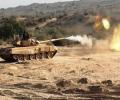
'It is ironic that General Rawat, an infantry officer who the government chose because of his expertise in counter-insurgency, has made his first bold statement in the realm of warfighting and mechanised operations,' points out Colonel Ajai Shukla (retd).

It will be interesting to see whether India-China border tensions figure during the deliberations of PLA deputies to the NPC and CPPCC, notes Jayadeva Ranade, the distinguished China expert and retired RA&W officer.
The latest WikiLeaks submission reveals a number of dubious attacks by Apache helicopters and raise the question of whether US pilots committed war crimes.
Whistle-blowing website WikiLeaks has released nearly 400,000 secret American documents on Iraq war, calling it the "largest classified military leak in history", despite Pentagon's warning that it could endanger informants and reveal war strategy.

His statement comes amidst reports of Chinese soldiers crossing the Line of Actual Control last week after some Tibetans hoisted Tibetan flags on the occasion of Dalai Lama's birthday on July 6.

'Perhaps the biggest indication was its striking decision in November to delink LeT from its aid certification process.' 'The administration decided that the US, in order to send military aid to Pakistan, would not need to certify that Pakistan is cracking down on LeT.' 'Perhaps the administration was trying to offer a carrot -- in effect, we're backing off on LeT, but in return we expect you (Pakistan) to go after the Haqqanis.' 'Either way, the optics were dreadful for the US given that Hafiz Saeed was released from house arrest a few days after the US move.' 'The US reacted angrily, but eventually it moved on, and refocused on its core concern: The Afghan-focused terror groups.'

The request was made in view of the upcoming elections for ICJ judges, scheduled to be held in November,
The government will recruit about 2,000 ex-servicemen specialised in commando and jungle warfare tactics to impart cutting-edge training to the Central Reserve Police Force personnel. The recruitment of these ex-servicemen, which will begin in May, assumes significance as 75 para-military personnel were massacred by Maoists in Chhattisgarh's Dantewada recently, raising questions on the operational strategies of the force.
There is no doubt that all terrorist organisations like the Taliban, Al Qaeda and Lashkar-e-Tayiba are operating with impunity in Pakistan. They may be loosely confederated, but their agendas are being synchronised and India after Afghanistan is their prime target.

China for the first time has divulged the deployment of a nuclear submarine for anti-piracy operations in the Gulf of Aden, a move defence experts say could cause unease among neighbours, including India.
India should adopt a pro-active strategy on Pakistan -- catalysing, facilitating and making room for a change in its anti-India posture.
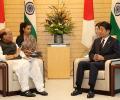
'Singh apprised the Japanese leaders about Islamabad's 'evil design' on Kashmir at a time when Pakistan has decided to internationalise the issue.'
Defence Minister A K Antony said on Sunday that the government viewed the violence unleashed by Maoists in some parts of the country very seriously.

China should not feel cornered by a raft of geopolitical moves by the US and Japan against it by forging closer ties with India, Russia and others in the region and Beijing should focus on becoming a strong economic and military power, a state-run daily said on Thursday.
The answer has two components: as a leader with a vision who can carry the masses and his ability to realise his vision through his decision-making and executive skills, says Col R Hariharan.

In a prime-time address from the military academy at West Point in New York, United States President Barack Obama on Tuesday unveiled his revised strategy for Afghanistan--which included sending an additional 30,000 troops to that war-ravaged country -- but was as much a new policy directive for Pakistan
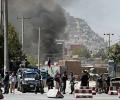
'Washington must retain control over any peace process until the Taliban gets worn out,' says Ambassador M K Bhadrakumar.

Even as the United States snuggles closer to India with the thinly veiled objective of containing China, the Indian strategy is to avoid alienating either nation.
US Defence Secretary Robert Gates on Wednesday held a meeting with visiting Chinese General Xu Caiho during which they discussed smoother military cooperation and a combined strategy to create a more stable and secure environment in Pakistan and Afghanistan.
India should carve out a policy response that protects India and its interests from the negative externalities of the US strategy in Afghanistan, writes Harsh V Pant.

The CPEC poses a clear and imminent danger to Indian security interests, says Kulbir Krishan.
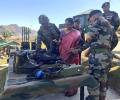
'We must look at the entire question of military preparedness anew, taking into account the new realities,' says Vice Admiral Premvir Das (retd).
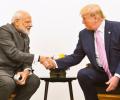
'From the Indian perspective, Trump's invitation to Imran Khan to visit the White House is a bitter pill to swallow,' points out Ambassador M K Bhadrakumar.

US Secretary of State Micheal Pompeo and Secretary of Defence James Mattis will travel to New Delhi next month for the 2+2 dialogue.

"We are now living in an era when non-state military actors are a major factor," Narendra Modi said in a veiled reference to threats posed to India from Pakistan
Even as the army battles Tehrik-e-Taliban Pakistan's militants headed by Hakimullah Mehsud, the government has decided to adopt another approach to end the spate of terror strikes on its soil. As part of this strategy, Interior Minister Rehman Malik has urged religious scholars to issue fatwas against the Taliban militants, by terming them as kafirs (non-believers).

An expert on South Asian affairs has said that the US can pursue, support and encourage Pakistan in its transition from tolerating to fighting the various militant groups on its territory, with the help of four policies.

With the commencement of the new year, the Centre has decided to strike the Naxals. The much-touted anti-Naxalite offensive of the Central para military forces in coordination with the state governments, which should have begun by now, has been quietly put off to January.
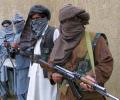
Qari Hussain Mehsud, warns of a new wave of suicide attacks in Pakistan.

'The Kashmir issue has become internationalised after nearly half a century.' 'India, not Pakistan, has done so pro-actively,' says Shekhar Gupta.

'Part of the problem lies in the US failure to stay focused on the goal of convincing Pakistan to crack down on terrorists that attack India.'

Arguing that Pakistan will remain a key player in counter terrorism post-2014, the United States has proposed $280 million in military assistance to the country, although it wants to cut civilian aid in an effort to acknowledge India's concerns about misuse of the funds.

BWith a distracted president brooding in the White House, Pompeo seems to think his day has come. He seems to be pushing a personal agenda before a target audience in America, observes Ambassador M K Bhadrakumar.
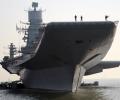
The navy wants to spend Rs 40,000 crore on INS Vishal, a choice the army and air force oppose. This is as much about turf as about funding. explains Ajai Shukla.

New Delhi must indicate to Afghan President Ashraf Ghani that it has a long-term strategy for his country. It should point out that Pakistan's present Afgan policy will destabilise Afghanistan and help Islamic State, says Gautam Sen.
 © 2026 Rediff.com - Advertise with us - Disclaimer - Privacy Policy - Sitemap - Feedback - About us - Terms of use - Grievances